Putting Beatrice Chepkoech's World Record 8:44 In Perspective
Putting Beatrice Chepkoech's World Record 8:44 In Perspective
Beatrice Chepkoech's world record of 8:44 made waves throughout the track world. But how does the mark compare to other world records?
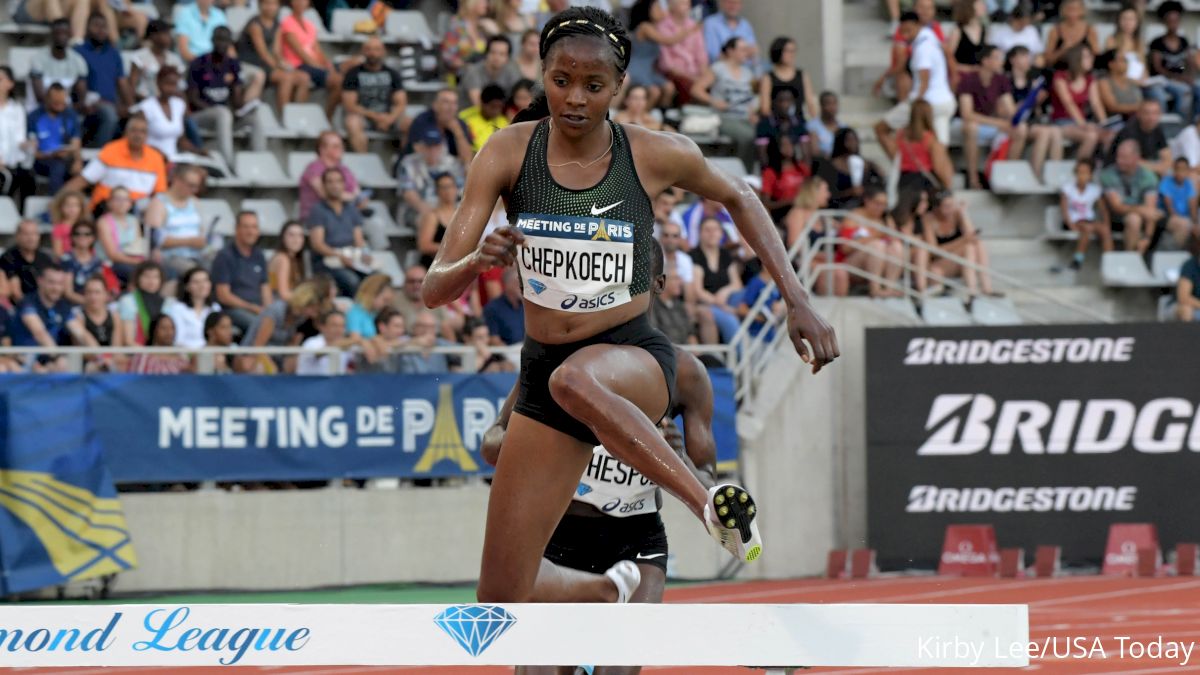
At last Friday’s Diamond League in Monaco, Beatrice Chepkoech made easy work of the greatest women’s steeplechase field ever assembled.
The start list included six of the eight fastest women of all-time. But you wouldn’t have known that watching the race.
After the first kilometer of 2:55, Chepkoech was alone. She covered the second kilometer in 2:54 as the field drifted out of camera view. With two laps remaining, Chepkoech was so far ahead of Ruth Jebet’s world record pace that she’d need an epic slowdown to miss the mark of 8:52.78.
Instead, she held steady.
Chepkoech closed the final 1,000 meters in 2:55, to finish in 8:44.32. Her margin at the finish was almost 100 meters. Courtney Frerichs ran 9:00.85 to finish second, the 13th best time in history, and was a straightaway behind.
There are many different ways to try and conceptualize Chepkoech’s run on Friday--there was the distance back to second place (again, almost 100 meters), her own personal improvement (15 seconds) and the staggering improvement over the old world record (more than eight seconds).
All are ridiculous to think about.
A world record broken by that amount is, by default, going to garner attention and speculation as the track world tries to wrap their heads around the idea of an 8:44.
This mark is particularly difficult to analyze. First, the women’s steeplechase is a relatively new event. It didn’t debut at the World Championships until 2005 and wasn’t run at the Olympics until 2008. For that reason, the event is more susceptible to larger improvements.
Second, the mark that Beatrice Chepkoech broke was held by Ruth Jebet who is facing a doping suspension. It’s important to note that American steepler Emma Coburn has said that a woman running 8:52 is possible, but it was Jebet’s rapid rise that made it obvious to her that the mark wasn’t above board. (Another point--having a world record set by someone under suspicion of doping isn’t unique to the women’s steeplechase).
That said, it’s worth taking a look at other top performances in track and field to see where exactly the 8:44 stands.
Below are three attempts to put Chepkoech’s run in perspective to see if it truly is an outlier performance, even amongst other world records. These methods, of course, aren’t the only ways to quantify her performance (and have their own limitations), but they can provide context around a woman running 8:44 in the steeplechase.
Method 1: IAAF Scoring Tables
The IAAF provides scoring tables that are used to “consistently measure and compare athletes and their performances across the rich variety of event disciplines.”
Though they don’t claim to be foolproof, the tables can be useful to see if 8:52 was out of step with other world records. Perhaps Chepkoech modernized the steeplechase by bringing it in line with the other world records?
| W 800 | W 1500 | W 3K SC | W 5K | W 10K |
| 1:53.28 | 3:50.07 | 8:44.32 | 14:11.15 | 29:17.45 |
| 1286 | 1287 | 1285 | 1260 | 1287 |
Amongst women’s performances, the women’s steeplechase is “better” than only the women’s 5000m, but is within two points of the 800m, 1500m and 10,000m.
Though the IAAF warns against comparing men’s and women’s events with the tables, here are point values for the same world record marks
| M 800 | M 1500 | M 3K SC | M 5K | M 10K |
| 1:40.91 | 3:26.00 | 7:53.63 | 12:37.35 | 26:17.53 |
| 1301 | 1302 | 1306 | 1294 | 1295 |
Method 2: Comparing Men’s And Women’s World Records In The Mid-Distance And Distance Races
This is a slight variation of the above. Here, the women’s and men’s world records are placed side-by-side.
Chepkoech’s performance is the closest to the men’s record of any of the mid-distance and distance races--9.67% behind Saif Saeed Shaheen’s 7:53.63. In the other four races, the women’s record is between 11.02 and 10.24% slower than the men’s world record.
| 800m | 1500m | 3000SC | 5000m | 10000m | |
| W | 1:53.28 | 3:50.07 | 8:44.32 | 14:11.15 | 29:17.45 |
| M | 1:40.91 | 3:26.00 | 7:53.63 | 12:37.35 | 26:17.53 |
| 89.08% | 89.54% | 90.33% | 88.98% | 89.76% |
Method No. 3: Comparing The World Record To The 10th Best Performer Of All Time
Here, we took the world record in the five distances and compared them to the 10th best performer of all-time in that event (note, 10th best performer, not performance).
Chepkoech’s run was 4.07% faster than the 10th best women’s steepler, Russia’s Yekaterina Volkova. That’s the largest margin between first and tenth of any of the distance events.
Is that to be expected in an event as “new” as the women’s steeplechase? If any of the above three comparisons would speak to the maturity of the event, it would be here, where one performance doesn’t carry as much weight.
Women's
| W 800 | W 1500 | W 3K SC | W 5K | W 10K | |
| #1 Performer | 1:53.28 | 3:50.07 | 8:44.32 | 14:11.15 | 29:17.45 |
| #10 Performer | 1:55.19 | 3:56.14 | 9:06.57 | 14:23.75 | 30:07.15 |
| 98.34% | 97.43% | 95.93% | 98.54% | 97.25% |
Men's
| M 800 | M 1500 | M 3K SC | M 5K | M 10K | |
| #1 Performer | 1:40.91 | 3:26.00 | 7:53.63 | 12:37.35 | 26:17.53 |
| #10 Performer | 1:42.37 | 3:28.80 | 7:58.15 | 12:48.77 | 26:38.76 |
| 98.57% | 98.66% | 99.05% | 98.51% | 98.67% |
In all of these methods, there’s room for speculation. Comparing world records to other world records is problematic if you think some of the marks aren’t credible. And relying on tables and charts to track performance has its limitations as well.
But with more races, starting at the Diamond League final at the end of August, we will begin to see if 8:40s is the new normal in the women's steeplechase, or if Chepkoech’s mark stands alone.